Accurate dental coding starts with the service that was actually performed and documented. The current CDT code communicates that service on the claim, but it does not determine whether the patient’s plan will pay. For 2026, practices need the current code set, updated systems and templates, complete clinical details, payer-appropriate attachments, and a final claim review.
Why coding errors start before submission
Most dental coding problems do not begin with a codebook. They begin earlier, when a clinical note is incomplete, a custom favorite still points to last year’s code, or an attachment requirement is discovered after the claim has already left the office. By the time the payer responds, the team is fixing several small gaps instead of one obvious error.
A safer workflow connects three responsibilities. The treating dentist documents the care. The practice selects the current code that accurately reports that care. The billing team checks that the claim fields and supporting information agree with the record. Coverage is reviewed separately. A plan’s payment policy should never be used to rewrite what was clinically performed.
What CDT codes do
The American Dental Association describes the Code on Dental Procedures and Nomenclature, commonly called the CDT Code, as a standardized code set that supports consistency in documenting dental treatment. It gives dental practices and payers a shared way to identify procedures on records and claims.
A CDT code reports what was done. It does not, by itself, determine whether a plan covers the service, how much the plan will allow, or what the patient owes. Those decisions depend on the benefit contract, network terms, limitations, deductibles, maximums, payer policies, and supporting information.
The ADA’s practical rule is “code for what you do.” That short instruction keeps the clinical record, code selection, and claim aligned without letting expected coverage reshape the procedure that is reported.
What changed in CDT 2026
The ADA reported 60 changes for CDT 2026: 31 additions, 14 revisions, six deletions, and nine editorial changes. The changes became effective January 1, 2026. Highlights included a broader update to anesthesia coding, new reporting options for point-of-care saliva testing and cracked-tooth testing, and changes involving resin-based composite reporting and preventive resin restoration.
Practices should not rely on an old cheat sheet or a copied fee schedule. Deleted codes, revised descriptions, and new reporting options need to be reflected in the practice management system, clinical templates, fee schedules, and team training. The licensed current CDT publication remains the authoritative reference for exact code language and application.
Three 2026 changes that show why implementation matters
The point of reviewing the annual update is not to memorize a list. It is to identify where the change touches the practice’s actual workflow. The ADA’s 2026 materials provide several useful examples:
- D0461 was added for cracked-tooth testing. A new reporting option matters only when the clinical team knows when it applies and documents the findings needed to support the service.
- The descriptor for D2391 was changed and D1352 was deleted. That combination means a practice should update favorites, fee schedules, clinical templates, and internal reference sheets rather than simply adding a new annual code list.
- D9230 was revised as part of broader anesthesia-related changes. Any affected practice should review current nomenclature, clinical documentation, software configuration, and payer guidance before submitting claims.
These examples are intentionally summarized. The exact nomenclature and descriptors are copyrighted and should be checked in the licensed CDT 2026 publication. Payer bulletins may also explain how a specific plan processes a valid code, which is a separate question from selecting the correct code.
Seven dental coding mistakes that disrupt claims
- Using an outdated code set. A code that was valid last year may be revised or deleted. Update the system before the new code year begins and audit custom favorites or templates.
- Selecting a code before the clinical record is complete. The record should describe the service, findings, diagnosis where applicable, tooth or area, materials, and relevant circumstances.
- Missing tooth, surface, arch, or quadrant information. The current ADA Dental Claim Form includes fields for oral-cavity area, tooth number or letter, and tooth surface when the procedure requires them.
- Confusing coding with coverage. Do not select a different code simply because one service appears more likely to be covered. Report the service that was actually provided and documented.
- Submitting weak or inconsistent documentation. Clinical notes, radiographs, periodontal charting, photographs, and narratives should support the service without contradicting one another.
- Skipping payer-specific attachment requirements. The code may be accurate while the claim remains incomplete because the payer needs additional evidence to make a benefit determination.
- Failing to review the final claim. Provider identifiers, dates, place of service, tooth details, fees, and attachments should be checked before the claim leaves the practice.
Documentation comes before claim submission
The ADA states that patient records are especially important when submitting dental benefit claims and that the dentist is responsible for the codes selected and documented in the patient record and billing systems. That makes clinical documentation a billing-control point, not just a clinical or legal requirement.
Good documentation is specific enough to support the service without being written as a generic insurance narrative. It should be created as part of care, signed or attributable to the responsible provider, and maintained consistently. Financial records and benefit breakdowns should be managed separately from the clinical record, according to the practice’s recordkeeping procedures.
A clean dental coding workflow
- Document the service. Complete the clinical note promptly and include the details needed to identify what was performed.
- Select the current CDT code. Use the licensed current-year reference and review the full nomenclature and descriptor rather than relying on memory.
- Match required claim fields. Confirm tooth, surface, arch, quadrant, date, provider, location, and fee information.
- Attach supporting evidence. Include required radiographs, charting, photographs, narratives, or other documentation in the payer’s accepted format.
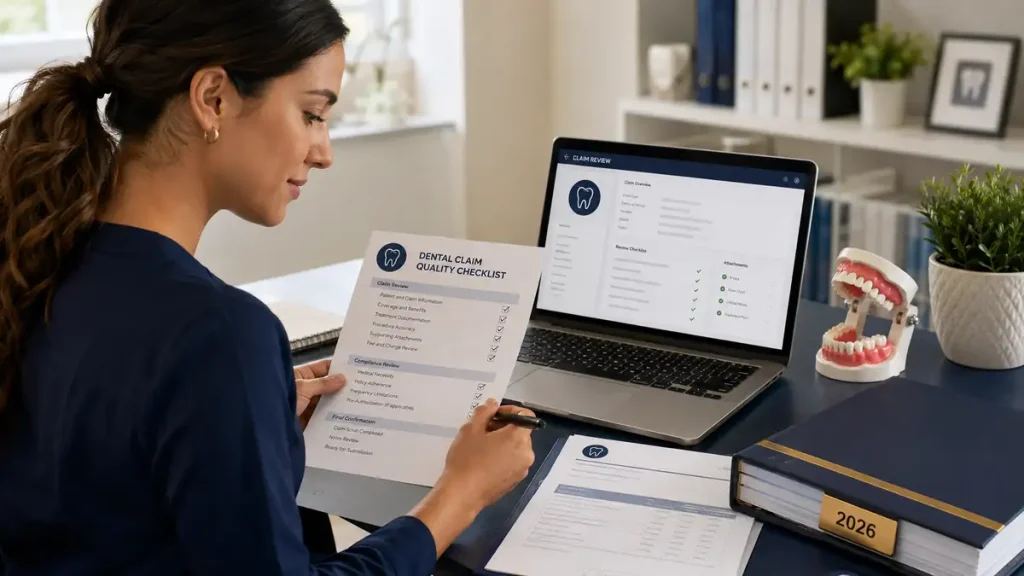
- Run a second-level review. Use a checklist or claim-editing rule to catch missing data and mismatches before submission.
- Track the payer response. Monitor acknowledgments, requests for information, denials, and payment. Feed recurring issues back into training and templates.
Separate the coding decision from the coverage check
A practical sequence is: first identify and document the service; then select the current CDT code; next complete the required claim fields and attachments; finally review the patient’s benefits and the payer’s processing policy. Keeping that order clear protects the clinical record from being shaped around a desired payment result.
If a plan does not cover the service, the answer is not to choose a different code. The answer is to document the service accurately, communicate the estimate and financial responsibility under the practice’s policy, and use the correct claim or reconsideration process when appropriate.
A practical CDT 2026 readiness checklist
- Confirm the practice has lawful access to the current CDT 2026 reference.
- Update practice management and clearinghouse code tables.
- Review the 31 additions, 14 revisions, six deletions, and relevant editorial changes.
- Remove deleted codes from favorites, macros, templates, and internal worksheets.
- Update clinical note templates and attachment checklists for affected procedures.
- Train dentists, hygienists, assistants, treatment coordinators, and billing staff on the changes relevant to their roles.
- Audit a sample of claims after implementation and correct system-level patterns rather than fixing each claim in isolation.
Corrected claim, additional information, or appeal?
The right response depends on what happened. If the practice submitted incorrect data, follow the payer’s corrected-claim process. If the payer needs documentation, provide the requested information through the approved channel and retain proof of submission. If the service was accurately coded and supported but the claim was processed inconsistently with the patient’s plan or payer policy, review the explanation of benefits and use the appropriate reconsideration or appeal process.
Do not repeatedly resubmit the same claim without understanding the status. Duplicate submissions can complicate follow-up. Assign a reason category, document each action, and set a next follow-up date so the claim remains visible until it is resolved.
Frequently asked questions
What is dental coding?
Dental coding is the use of the current CDT code set to report dental procedures consistently in patient records and on claims. Accurate coding must reflect the service actually performed and documented.
How often are CDT codes updated?
The CDT code set is updated annually. Practices should review and implement the new version for its effective year rather than relying on old reference sheets.
How many changes were made for CDT 2026?
The ADA reported 60 changes: 31 additions, 14 revisions, six deletions, and nine editorial changes, effective January 1, 2026.
Does the correct CDT code guarantee insurance payment?
No. The code reports the procedure, while payment depends on eligibility, plan coverage, limitations, network rules, documentation, maximums, deductibles, and payer processing.
Who is responsible for the code used on a dental claim?
The ADA states that the dentist is responsible for the codes selected and documented in the patient record and billing systems, even when team members help prepare the claim.
Build a more predictable revenue cycle
Premier Dental RCM supports dental practices across the United States with eligibility verification, insurance billing, payment posting, denial follow-up, credentialing, and accounts receivable management. If your collections do not reflect your production, request a complimentary revenue assessment to identify where the process is breaking down. Editorial disclaimer: CDT content is copyrighted by the American Dental Association. Use the licensed current CDT publication for exact code language. This article provides general operational information and is not coding, legal, or reimbursement advice.